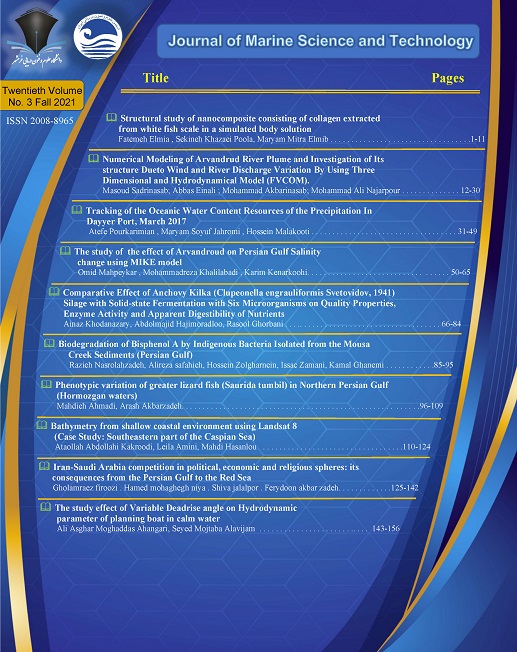
Journal of Marine Science and Technology

Journal of Marine Science and Technology

Analysis of oblique water entry of wedge and parametric investigation of pressure distribution

Document Type : Original Manuscript

Authors
Department of marine Engineering, amir kabir University, Tehran, Iran
Abstract
In past few years two-dimensional theories in numerical, analytical and experimental solution have contributed in seakeeping and maneuverability of vessels specially planing crafts. Analysis of wedge water entry as a basic problem has wide application. Till now much research in different methods has been done on the symmetric and asymmetric of wedge water entry. in this study wedge water entry with transverse velocity (or oblique water entry) will be studied. Model testing is a powerful means to deal with the said problem, in this study oblique water entry of wedge has been conducted. In this regard for oblique water entry of wedge a setup has been designed and fabricated. using by the fabricated setup a set of oblique water entry tests on wedge of 40 degree deadrise angle in different vertical and transverse velocity are examined and the pressure distribution on the plates of wedge due to impact of water are recorded. The results are illustrated the importance of transverse velocity on the pressure distribution and magnitude of vertical and transverse forces on the wedge. The pressure distribution due to oblique water entry on left and right side of the wedge are not symmetry; owing to increasing of transverse velocity the difference pressure on two sides of wedge is increased, so the transverse force is increased and the vertical force is decreased.
Keywords

Subjects


Fairlie-Clarke, A., 2008. Momentum and gravity effects during the constant velocitywaterentryofwedge-shapedsections. J.OceanEng, جلد 35 (2008), p. 706–716.
Gu, H., 2014. Numerical simulation of water impact of solid bodies with vertical and oblique entries. Ocean Eng.75, pp. 128-137.
Judge, C., 2004. Initia lwater impact of a wedge at vertical and oblique angles. Eng.Math, pp. 279-303.
Mayo, W., 1945. Analysis and modification of theory for impact of seaplanes on wtare, NACA Technical .
Milwitzky, B., 1948. A generalized theoretical and experimental investigation of the motions and hydrodynamic loads experienced by V-bottom seaplanes during step-landing impacts, NACATN1516.
Savander, B., 2002. Steady hydrodynamic analysis of planing surfaces. J.ShipRes, pp. 71-95.
Sebastiani, L., 2008. A practical method for the prediction of planing craft motions in regular and irregular waves. Estoril, Portugal.
Smiley, R., 1952. A theoretical and experimental investigation of th eeffects of yaw on pressures, forces and moments during seaplane landings and planing, National Advisory Committee For Aeronautics (NACA)Technical Note no.2817.
Von Karman, T., 1929. The impact on seaplane floats during landing, NACATN321.
Wagner, H., 1932. Phenomena associated with impacts and sliding on liquid. Math.Mech., 12(4), pp. 193-235.
Zarnick, E., 1978. A Nonlinear Mathematical Model of Motions of a Planing Boat in Regular Waves, Bethesda,MD: DTNSRDC Report 78/032.David W. Taylor Naval Ship Research and Development Center.

  • Receive Date 09 October 2016
  • Revise Date 03 October 2017
  • Accept Date 15 October 2017
  • Publish Date 20 April 2020