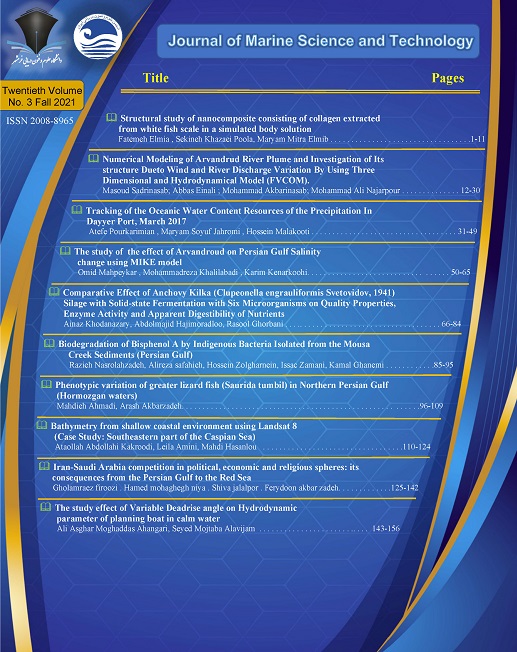
Document Type : Original Manuscript
Authors
1
PhD in Strategic Management, Supreme National Defense University, Tehran, Iran.
2
PhD in Meteorology, Imam Khomeini University of Marine Sciences, Nowshahr, Iran.
Abstract
Abstract
The quality of learning in maritime education is of particular importance due to international regulations and the safety-critical nature of this profession. This study aimed to evaluate the relationship between motivations for choosing a seafaring career and students’ learning quality, and to provide strategies for improving the quality of seafarers’ education. In terms of purpose, the study was applied; in terms of method, it was descriptive (case-based/contextual) with a mixed-methods approach. Data were collected from library resources and documents and then supplemented by quantitative questionnaire-based analysis. The statistical population consisted of 100 Marine Engineering students (Navigation and Ship Command) at Islamic Azad University, Marine Science Branch, selected through convenience sampling. The revised two-factor Study Process Questionnaire (R-SPQ-2F; Biggs et al., 2001) and a 47-item questionnaire on career choice motivations were used. Data were analyzed using SPSS, descriptive statistics, non-parametric tests, factor analysis, and Spearman correlation. The results showed that deep learning had a positive correlation with affective attractions (rho = 0.316), personal talent and interest (rho = 0.313), and perceived professional advantages of the seafaring career (rho = 0.186). Surface learning had a positive correlation with random career choice (rho = 0.432) and family influence (rho = 0.282). Students who choose seafaring based on genuine interest, talent, and awareness of professional advantages have higher-quality learning, whereas random choice or external pressure is associated with surface learning and lower educational quality.
1. INTRODUCTION
The quality of learning among seafarers is a critical and multidimensional issue (Heywood, 2000). One important perspective is students’ approach to learning as an individual characteristic linked to motivation and learning strategies (Diseth & Martinsen, 2003). Marton and Säljö (1976), by examining students’ conceptions of learning, identified five categories (increasing knowledge, memorisation, acquiring facts or methods, abstraction of meaning, and an interpretative process aimed at understanding reality); later, a sixth category emerged: a conscious process with personal motivations toward creating harmony or change in society (Van Rossum, 1984). Biggs (1987) considered the approach to learning to consist of two components, motivation and strategy, and developed Marton’s model. He designed the Study Process Questionnaire (SPQ) and then the shorter 20-item R-SPQ-2F to measure surface and deep approaches (Biggs et al., 2001). The present study aims to examine the motivations determining the choice of a seafaring career and to identify the individual characteristics and learning approaches of maritime students.
2. MATERIALS AND METHODS
This study was applied in purpose and descriptive (case-based/contextual) with a mixed-methods approach. The statistical population consisted of 100 Marine Engineering students (Navigation and Ship Command) at Islamic Azad University, Marine Science Branch, selected through convenience sampling; after completing the questionnaire, their grade point averages were recorded through self-report. The revised two-factor Study Process Questionnaire (R-SPQ-2F; Biggs et al., 2001) and a seafaring career choice motivation questionnaire with 47 items were used. The validity of the questionnaires was assessed using confirmatory factor analysis and Varimax rotation; KMO was 0.838 for the first questionnaire and 0.852 for the motivation questionnaire, and Bartlett’s test of sphericity was significant for both (p = 0.000). Factor analysis extracted four factors for the first questionnaire with factor loadings from 0.543 to 0.817, explaining 52.23% of the variance, and twelve factors for the motivation questionnaire. Reliability was measured using Cronbach’s alpha, and six composite variables with coefficients from 0.677 to 0.914 were used for correlation analysis. Data were analyzed using SPSS, descriptive statistics, non-parametric tests (Kruskal–Wallis and Mann–Whitney), factor analysis, and Spearman correlation because the variable scores were not normally distributed (Morgan et al., 2007).
3. RESULTS
The most important motivations for choosing a seafaring career were: a respectable and prestigious job (89.7%); people view seafarers more favorably (85%); seafaring is a masculine job (84.2%); the possibility of earning a good income (81.6%); seafaring can be a good job (79%); working at sea is interesting (76.8%); seafarers can support their families (76%); the opportunity for higher education (74.3%); dreaming of becoming a captain/navigator or ship engineer (74.3%); seafarers are regarded as skilled professionals (73.3%); seafarers’ lives are adventurous and exciting (72.9%); the seafaring profession is attractive (70.8%); it offers good prospects for coastal residents (60.9%); and it is a global profession (52.6%). However, some negative or instrumental views were also present: 29.2% completely or partly agreed that “my intention is to obtain a degree and get employed, and I try not to build my career at sea”; 27.9% said they would have liked to continue their studies in other fields but were not accepted; and 26.6% said they entered this profession due to parental pressure. Factor analysis of the 47 items revealed twelve factors. Deep approach had a positive correlation with affective attractions (rho = 0.316, p = 0.000), personal talent and interest (rho = 0.313, p = 0.000), and perceived professional advantages (rho = 0.186, p = 0.005). Surface approach had a positive correlation with random career choice (rho = 0.432) and family influence (rho = 0.282). These results indicate that students who choose the seafaring career based on talent, affective attraction, and professional advantages adopt a deep approach and have higher learning quality. In contrast, students who choose randomly or under family influence have a surface approach and experience lower learning quality.
4. DISCUSSION AND CONCLUSION
The study concludes that motivations for choosing a seafaring career among young people are mainly determined by economic factors (good salary, family welfare, job opportunities), social factors (desire for higher education, prestige and status of seafaring, perception of seafarers as skilled professionals, and good prospects for coastal residents), and psychological factors (interest in maritime work, the dream of becoming a captain or engineer). Correlation analysis showed that deep learning is related to affective attractions, personal talent and interest, and perceived professional advantages. Surface learning is related to random career choice and family influence. Therefore, if students choose the seafaring career with the aforementioned positive motivations, their learning is of higher quality. If they choose randomly or under family influence, learning quality is lower. The findings also show that first-year students are more inclined toward deep learning than students in later semesters. Maritime universities should explain all positive features of the seafaring profession to young people and provide opportunities for informed and interest-driven choice. This can improve the quality of maritime education and learning. In practice, maritime education institutions should strengthen career counselling, provide realistic information, identify students with genuine interest and talent, and design curricula to foster deep learning strategies. Policymakers should also consider motivational factors in admission and education policies to improve the quality of seafarer education and ultimately maritime safety.
References:
Biggs, J.B., 1987. Student Approaches to Learning and Studying. Research Monograph. Australian Council for Educational Research Ltd., Radford House, Frederick St., Hawthorn 3122, Australia..
Biggs, J., Kember, D. and Leung, D.Y., 2001. The revised two‐factor study process questionnaire: R‐SPQ‐2F. British journal of educational psychology, 71(1), pp.133-149. https://doi.org/10.1348/000709901158433
Diseth, Å. and Martinsen, Ø. (2003) ‘Approaches to learning, cognitive style, and motives as predictors of academic achievement’, Educational Psychology, 23(2), pp. 195–207. doi: 10.1080/01443410303225.
Heywood, J., 2000. Assessment in Higher Education: Student Learning, Teaching, Programmes and Institutions. London: Jessica Kingsley Publishers.
Marton, F. and Säljö, R., 1976. On qualitative differences in learning: I—Outcome and process. British Journal of Educational Psychology, 46(1), pp. 4–11. doi: 10.1111/j.2044-8279.1976.tb02980.x.
Morgan, G.A., Leech, N.L., Gloeckner, G.W. and Barrett, K.C., 2007. SPSS for Introductory Statistics: Use and Interpretation. 3rd edn. Mahwah, NJ: Lawrence Erlbaum Associates.
Van Rossum, E. J. (1984). The relationship between learning conception, study strategy and learning outcome. British Journal of Educational Psychology, 54(1), 73–83.
Keywords
Subjects